Sudden Oak Death Syndrome

Phytophthora ramorum

Werres et al.

Last updated by: 
Faith Campbell
  • Infests plants in more than 70 genera; some are killed, others survive; some hosts support spread of the infection (see detailed descriptions below).

  • Host genera include ashes, California bay laurel (Oregon myrtle), camellias, Douglas-fir, hemlock, huckleberries, larch, lilacs, madrone, magnolias, maples, mountain laurel, oaks, redwoods, rhododendrons, and viburnums,

  • Phytophthora ramorum was probably introduced to North America on infected imported plants in the late 1980s or early 1990s.

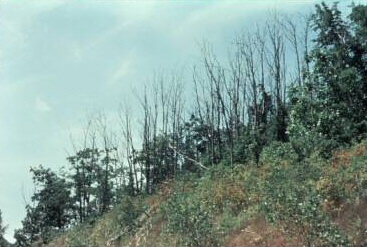
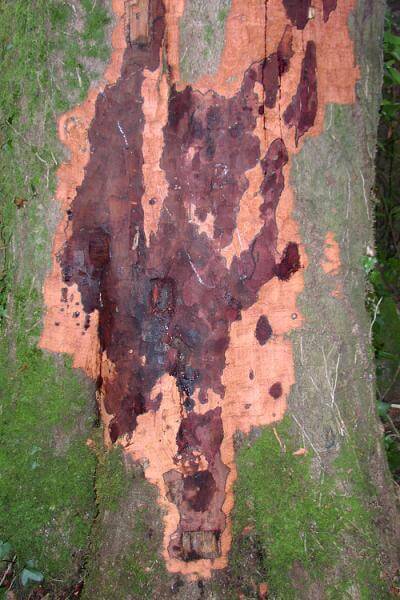
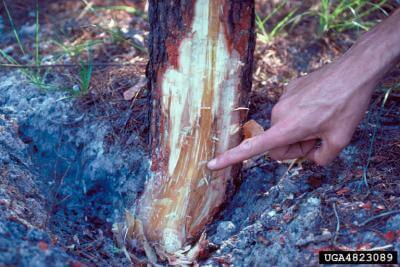
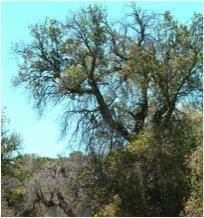
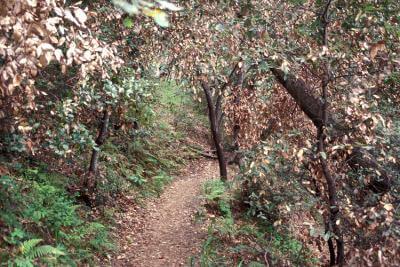
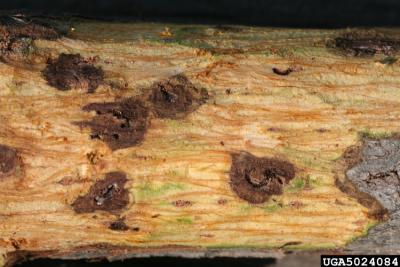
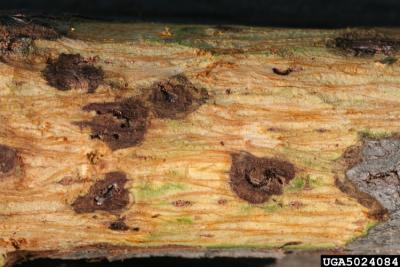
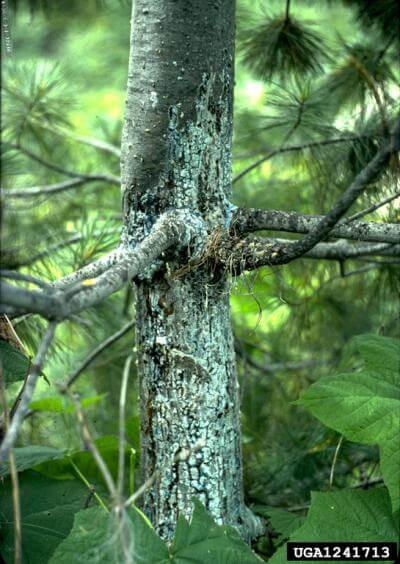
Sudden Oak Death (SOD) was first identified in the mid-1990s, when a large number of oaks and tanoaks began dying off in California’s coastal hardwood forests apparently victims of an then unknown disease . By the summer of 2000, the pathogen causing SOD was isolated, and was subsequently named Phytophthora ramorum. Since 2004, SOD has been recognized in 14 coastal California counties, from Monterey north to Humboldt, as well as in Curry County, Oregon. While the disease has continued to spread within the infested area, no new counties in either state have been found with the pathogen.

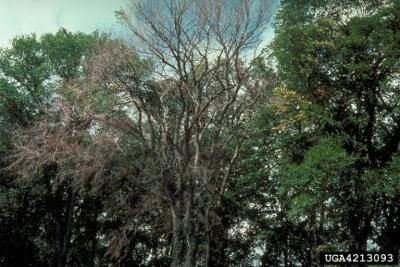
In the affected Pacific coastal region, SOD has killed well over a million trees. Plants mortally affected by the pathogen include tanoak (Notholithocarpus densiflorus), coast live oak (Quercus agrifolia), California black oak (Q. kelloggii), canyon live oak (Q. chrysolepis), and Shreve's oak (Q. parvula var. shrevei). When plants are small, or in instances where there is a heavy inoculum load, rhododendron, camellia, madrone (Arbutus menziesii), evergreen huckleberry (Vaccinium ovatum), and other hosts may also succumb to the pathogen. In addition, several conifers have been identified as hosts, although the impact of the pathogen on them remains unclear. In the US, these include coastal redwood (Sequoia sempervirens), Douglas-fir (Pseudotsuga menziesii), grand fir (Abies grandis), and Pacific yew (Taxus brevifolia). In the United Kingdom (UK), they include Japanese larch (Larix kaempferi) and western hemlock (Tsuga heterophylla - native to North America), each of which were identified in 2009. In all, 127 plant species are currently recognized by the US as hosts of P. ramorum; however, as the list can change, it is important to reference the USDA Animal and Plant Health Inspection (APHIS) website http://www.aphis.usda.gov/plant_health/plant_pest_info/pram/downloads/pdf_files/usdaprlist.pdf for the most current information. Many hosts do not die if infected, but rather act as sources of inoculum. Of those hosts that support inoculum production, California bay laurel (Umbellularia californica) and tanoak are considered to be the driving force of pathogen distribution in California and Oregon forests, with spores readily building up on the leaves and twigs, and then dispersing into the local environment.

In California and Oregon, some of these species are the dominant hardwoods over large areas, growing in nearly pure stands. P. ramorum is now known to infect nearly all of the major trees species in California’s infested counties. At present, the pathogen is found in only about 10% of California’s forest area considered to be at risk. According to a model developed by Ross Meentemeyer (University of North Carolina, Charlotte), in the absence of any control efforts, the epidemic may increase ten-fold by 2030 along the coast, from the San Francisco Bay Area into Oregon.

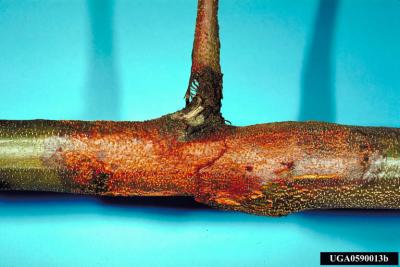
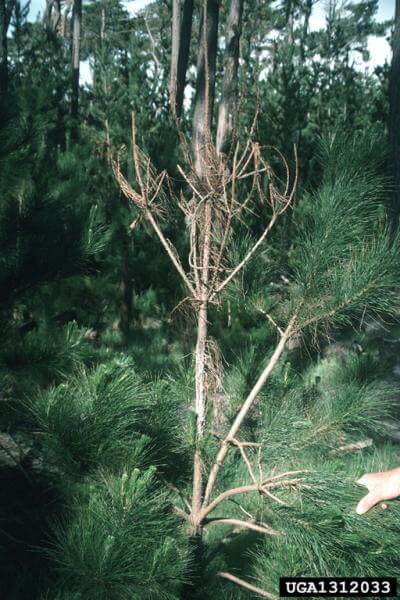
Recent testing of UK sites known to have P. ramorum has found the pathogen in mature larch plantations, infecting shoots and foliage, producing wilted, withered shoot tips, blackened needles, and branch dieback. Large areas of larch are being cut to prevent pathogen spread. Understory beech, birch, oak, and western hemlock have all been found with bole cankers. Some of the confirmed sites have little or no rhododendron present. Prior to these findings in 2009, tree infection in the UK has only been identified in relatively close proximity to infected rhododendron.

Phytophthora ramorum is a non-native, invasive species in North America and Europe. It is believed that the pathogen was imported to both continents via the ornamental plant trade through several separate introductions from probably more than one unknown location. Through genotyping efforts, three clonal lineages have been identified – two in North America (NA1 and NA2) and one in the Europe (EU1) – all of which likely diverged more than 100,000 years ago. At least four global migrations of the pathogen have occurred, with the NA1, NA2, and EU1 lineages being imported into North America, and the EU1 lineage into Europe. Canada has had all three lineages since 2004. It is believed that the US and Canada received the EU1 lineage unknowingly through importation from Europe. Shipment of the pathogen to eastern North American nurseries has since occurred from California and the Pacific Northwest. To date, the three lineages have not been found recombining in natural settings; however, there is still apprehension over their coexisting in one location at a given time, as a hybridized genotype could cause even more die-off and would further complicate suppression and containment efforts.

There is concern that P. ramorum could become established in eastern North America, causing significant damage if the pathogen were introduced to the natural environment in a location where host plants and climatic conditions were conducive to pathogen viability. Many tree and shrub species native to the East Coast are hosts of the pathogen, as demonstrated by laboratory studies or natural infection of the species in plantings in Europe. Species of concern include northern red oak (Quercus rubra), chestnut oak (Q. prinus), white oak (Q. alba), pin oak (Q. palustris), sugar maple (Acer saccharum), black walnut (Juglans nigra), and mountain laurel (Kalmia latifolia). Of most concern is northern red oak as it has been found naturally infected in Europe and is highly susceptible in laboratory studies. Northern red oak is an extremely valuable wildlife food source and valuable for timber and oak veneer. Chestnut oak is also a concern as it has been found to be a susceptible stem and foliar species based on inoculation studies. This species is a dominant tree in the Piedmont and mountain regions, and its acorns are an important food source for wildlife. National risk maps are available (http://www.suddenoakdeath.org/html/modeling_phytophthora_ramorum.html) based on both host presence and climatic variables favorable to the disease.

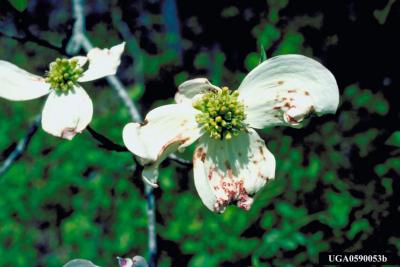
To determine pathogen viability in the eastern US, it is necessary to establish if there are host plants present that will support sufficient levels of pathogen sporulation. Research to date has found that mountain laurel may die too quickly once infected to support pathogen spread. While eastern rhododendrons have not yet been tested, rhododendrons are key sporulating hosts in Europe (where the EU1 lineage is found). Tooley and Browning (2009) determined that a number of common plants in eastern deciduous forests are foliar (sporulation potential) hosts, including flowering dogwood (Cornus florida), sassafras (Sassafras albidium), black locust (Robinia pseudoacacia), black cherry (Prunus serotina); and two widespread invasive species, Japanese honeysuckle (Lonicera japonica) and multiflora rose (Rosa multiflora).

Disease management in the West

In 2001, Oregon forest pathologists detected P. ramorum in Curry County (southwest Oregon, just north of the California border). State and federal agencies there continue to try to eradicate outbreaks. As the pathogen is a water-loving organism, weather plays a vital role. Oregon’s affected region is relatively small, with treatment areas covering approximately 600 to 700 acres per year (the Oregon quarantine area is currently 162 mi2). Since 2001, the eradication program has cost almost $4.5 million, nearly all in federal funds. This effort has not completely eradicated the pathogen. P. ramorum is still present on three percent of all samples, with 38 percent of treated sites found to have positive soil and 10 percent of sites with positive plant material. However, the aggressive early detection and targeted tree removal has had very good success at containing P. ramorum to a relatively small area. Several of the treated sites do appear pathogen free two years after treatment.
To date, no cure for sudden oak death in forest ecosystems has been found. One treatment has been approved for use in California (phosphonate Agri-Fos®) on individual oaks and tanoaks; however, it is only effective in preventing healthy trees from becoming infected. While Agri-Fos® was originally only used to treat individual, high-value landscape trees, several studies are now under way regarding its potential for use to protect trees in forests.

Preventing spread of P. ramorum to uninfested areas of the country

Several common nursery trade species, such as rhododendron, camellia, viburnum, pieris, and kalmia, are also P. ramorum hosts. Given the relatively recent identification of the pathogen, the steep learning curve associated with its discovery, and the great variability of symptoms on hosts, it is not surprising that the pathogen has been unknowingly shipped on nursery stock. Awareness of this risk exploded in the spring of 2004 when officials discovered the disease on camellias at a large California nursery that shipped $30 million worth of plants interstate on an annual basis. By the end of 2004, 176 nurseries in 21 states had received infected plants, 125 of which were linked to the California supplier.
After some states took unilateral action, the USDA Animal and Plant Health Inspection Service (APHIS) imposed an Emergency Federal Order on the interstate movement of nursery stock, cut greens, and other host plant material from California, Oregon, and Washington (Code of Federal Regulations: 7 CFR 301.92 - http://www.gpoaccess.gov/cfr/retrieve.html - URL goes to CFR website where current regulations can be retrieved by entering 7 as title; 301 as part; 92 as section into correct boxes and leaving year as most recent). Federal regulations were first implemented in 2002; however, prior to 2004, they only included the 14 infested California counties and the infested area of Curry County, Oregon.

These regulations have substantially reduced the presence of P. ramorum on nursery stock; however, they have not successfully eliminated it. In both 2008 and 2009, more than 20 nurseries nationwide were found to have infected plants. These included nurseries in AL (3), GA (2), MS (1), NC (2), NJ (1), SC (1), WA (6), OR (6), and CA (4) [numbers in parentheses here and throughout this article refer to number of infested nurseries in each state]. There was also one nursery perimeter confirmation (WA) and six detections in the landscape – primarily plants in gardens detections with various pathogen lineages found in four states (WA, MD, PA, SC) other than California.

A major concern is the continuing presence of nurseries that have been found to have P. ramorum-positive plants more than one year, despite having carried out the USDA APHIS Confirmed Nursery Protocol (http://www.aphis.usda.gov/plant_health/plant_pest_info/pram/downloads/pdf_files/CNPv8.0-Oct-08.pdf). In such instances, it is often not clear whether the infestation has persisted or has been re-introduced to the nursery from another location. Genetic testing for the pathogen lineage would help to distinguish between repeat nurseries and new introductions; however, such rigorous analysis is not required. The pathogen can persist in plant material, water, soil, and growing media, including on recycled pots.

Another concern is the extent to which P. ramorum can escape infested nurseries (or diseased nursery stock planted in yards or other places) and cause disease in native plants. In some cases, vegetation outside infested nurseries has been found infected, as was the case in 2009 in Washington, when infected salal (Gaultheria shallon) plants growing on a stream bank outside an infested nursery were found to be P. ramorum-positive. Water from the infested nursery area ran off into the native salal stand. The salal has since been removed, and plans are under way to pave over the area. This was the first documented incident of P. ramorum moving out of an infested nursery and causing disease outside the nursery. APHIS began requiring testing of water inside infested nurseries in 2005; however, only nursery water used for irrigation is required to be cleaned up if the pathogen is found. Other water found onsite can remain contaminated, regardless of its threat to plants and the surrounding landscape if a flood were to occur. P. ramorum has also escaped from some nurseries into streams and occasionally landscape vegetation in Florida, Mississippi, North and South Carolina, and Texas. Whether the pathogen will spread further in these regions is not yet known.

The USDA Forest Service (FS) has been testing streams since 2006 as part of the P. ramorum of Forest Environments. In total, 320 unique watersheds have been surveyed. As of 2009, this survey has identified seven outbreaks in the three Pacific Coast states. Of the Pacific Coast water confirmations, two were Washington waterways found positive in more than one year, with one of the waterways having more than one pathogen lineage present in a given year. The survey has also identified five southeast streams with P. ramorum, all of which have persisted each subsequent year despite upstream nurseries taking action to eliminate the pathogen at their facilities. Those states are MS (1), AL (2), GA (1), and FL (1). Oregon and California operate additional, more extensive, stream survey programs. Oregon has never found P. ramorum in streams outside the Curry County outbreak area.

Nursery management practices are key to elimination of the pathogen in the ornamental nursery industry. There is agreement that the most effective program would rely on a critical control point strategy or systems-based approach using the best available science. While a couple of recommended best practices programs have been proposed since 2005, implementation has only occurred in Oregon through the Grower Assisted Inspection Program (GAIP).

Europe

The European (EU1) and US lineages (NA1, NA2) of P. ramorum have different environmental and host preferences, and seemingly different levels of virulence. The origin of the European strain, like the US strain, is from an unknown location; however, it is likely from a different source than the US source given the different lineage.

Before the pathogen was formally named, in Europe the pathogen was found on German nursery landscape rhododendron plants in the mid-1990s. In 2004 it was found in nurseries in at least 11 European countries. By 2009, P. ramorum had been found in nurseries or gardens in 22 European countries, from Ireland and Norway to Poland and Serbia.

In autumn 2003, UK scientists detected the first cases of nearby trees becoming infected as a result of spores from outplanted nursery stock. By 2008, there were burgeoning reports of landscape outbreaks throughout Europe, with 14 countries affected; however, infected forest trees are still found only in the UK and Netherlands. Of the impacted European countries, the UK has had the greatest number of infestations, with more than 150 outbreaks in managed gardens, woodlands, or wild planting areas in England, Wales, and Scotland. Concern there over the health of ecologically valuable heathlands is great, as bilberry (Vaccinium myrtillus) is the dominant species, and it is highly vulnerable to the pathogen, as well as a good supporter of its sporulation. Four of the seven types of the world’s heathland occur in England, with the UK supporting approximately 75% of the total (global) upland habitat.

In spring 2009, the UK Government launched a 5-year program aimed at reducing P. ramorum and P. kernoviae inoculum to epidemiologically insignificant levels. Program components include removal of the principal sporulating host (the exotic plant Rhododendron ponticum) and the identification and control of any new outbreaks, helping to minimize the risk of further disease development or pathogen spread. P. ramorum and P. kernoviae research continues to improve understanding of the diseases they cause as well as to identify more effective control measures. To implement the 5-year program, £4 million was allocated for the first three years.

For more information on P. ramorum and Sudden Oak Death, go to the California Oak Mortality Task Force website at www.suddenoakdeath.org.

This write-up benefitted from significant input from Katie Palmieri of theCalifornia Oak Mortality Task Force.


Sources

European Union. 2009. Risk Analysis of Phytophthora ramorum, a Newly Recognised Pathogen Threat to Europe and the Cause of Sudden Oak Death in the USA. http://rapra.csl.gov.uk/.

Frankel, S.J., J.T. Kliejunas, and K.M. Palmieri, technical coordinators. 2008. Proceedings of the sudden oak death third science symposium. Gen. Tech. Rep. PSW-GTR-214. Albany, CA: U.S. Department of Agriculture, Forest Service, Pacific Southwest Research Station. 491 p. Available online at: http://www.fs.fed.us/psw/publications/documents/psw_gtr214/.

Frankel, S.J., J.T. Kliejunas, and K.M. Palmieri, technical coordinators. 2010. Proceedings of the sudden oak death fourth science symposium. Gen. Tech. Rep. PSW-GTR-XXX. Albany, CA: U.S. Department of Agriculture, Forest Service, Pacific Southwest Research Station. In press.

Goss, E.M.; Larsen, M.; Chastagner, G.A.; Givens, D.R.; and Grünwald, N.J. 2009. Population genetic analysis infers migration pathways of Phytophthora ramorum in US nurseries. PLoS Pathog 5(9): e1000583.

Hansen, E.M., A. Kanaskie, S. Prospero, M. McWilliams, E.M. Goheen, N. Osterbauer, P. Reeser, and W. Sutton. 2008. Epidemiology of Phytophthora ramorum Oregon tanoak forests. Can. J. For. Res. 38:1133-1143. DOI: 10.1139/X07-217.

Kliejunas, John T. 2007. Sudden Oak Death and Phytophthora ramorum: A Summary of the Literature. Albany, California. Pacific Southwest Research Station, Forest Service, U.S. Department of Agriculture. http://www.suddenoakdeath.org/html/sod_literature_summary.html.

Mascheretti, S.; Croucher, P.J.P.; Kozanitas, M.; Baker, L.; and Garbelotto, M. 2009. Genetic epidemiology of the Sudden Oak Death pathogen Phytophthora ramorum in California. Molecular Ecology 18: 4577–4590.

Rizzo, D.M. and M. Garbelotto. 2003. Sudden oak death: endangering California and Oregon forest ecosystems. . Ecol. Environ. 1(5): 197-204.

Tooley, P. and Browning, M. 2009. to Phytophthora ramorum Inoculum Production Potential of Some Common Eastern Forest Understory Plant Species. Plant Disease 93:3 Pages 249-256.

Tooley, P. and Kyde, K. 2007. of Some Eastern Forest Species to Phytophthora ramorum. Plant Disease , 435–438.

Werres, S.; Marwitz, R.; Man Int Veld, W.A.; Cock, A.W.; Bonants, P.J.M.; De Weerdt, M.; Themann, K.; Ilieva, E.; and Baayen, R.P. 2001. Phytophthora ramorum sp. nov., a new pathogen on Rhododendron and Viburnum. Mycol. Re. 105: 1155-1165.

Signup to receive one of our newsletters

Monthly updates on firewood outreach, regulation, and industry
Quarterly updates on firewood and forest issues of general interest
Help