



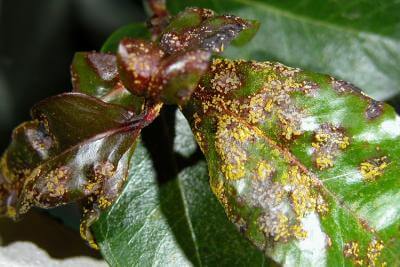
- ‘Ōhi‘a rust, also called myrtle rust, eucalyptus rust or guava rust, is a rust apparently native to parts of the American tropics. It was first described on guava (Psidium pomiferum) in Brazil in 1884 (Loope and La Rosa, 2008). Austropuccinia psidii is unusual among rusts in having a wide host range. Of the nearly 6,000 plant species (in about 132 genera) in the family Myrtaceae, more than 500 species in nearly 100 genera (or 9% of species, two-thirds of the genera) worldwide are known to be hosts. Some are killed, others survive; some hosts support spread of the infection. The IUCN Red list includes at least 338 species in the family—before determining impacts of the rust.
- It has been introduced to 27 countries on several continents, most worrying has been the spread across the Pacific beginning after 2000. Some of these countries have a relatively low level of myrtaceous diversity at both species and generic levels, although they might still be an important component of the natural ecosystems and cultural heritage—as is the case in Hawai`i and New Zealand.
- Known to infect 539 species worldwide from 86 different genera – all in the Myrtaceae family. Some are killed, others survive; some hosts support spread of the infection. The IUCN Red list already includes 338 species in the family – before determining impacts of the rust (CABI)
- The Myrtaceae family is particularly prominent in Australia, New Zealand, and other forested areas associated with the former supercontinent of Gondwanaland. Host species and genera include the dominant tree genera in Hawai`i (ʻōhiʻa lehua), Oceania (Eucalyptus, Melaleuca). Eucalyptus is widely used in forestry around the world.
- One principal pathway of introduction is imports of infected plants or plant parts. Other possible pathways include timber and wind.
- Nine biotypes are known. The “pandemic” biotype has been introduced to Oceania, Asia and the Pacific, including Hawai`i, Australia, New Zealand, New Caledonia, and Florida. This biotype is not known to be present in Brazil. A distinct biotype has been introduced to South Africa (Toome-Heller et al. 2020).
The rust experienced a rapid dispersal after 2000. It was detected in Hawai`i in 2005, Japan in 2007, China in 2009, Australia in 2010, New Caledonia and South Africa 2013, Indonesia and Singapore in 2016, and New Zealand in 2017.
In New Zealand Austropuccinia psidii is reproducing sexually. Michael Bartlett and colleagues genotyped 379 pustules collected from 10 geographic populations in New Zealand on three different host species, including samples from the original 2017 incursion. They detected high genotypic diversity, a high effective population size, and production of sexual spores in most populations. These findings support the occurrence of frequent recombination, likely driven by sexual reproduction. There are serious implications for management, including efforts to detect resistance in endangered host populations and enhance it through breeding, the potential for fungicide resistance, and the higher potential for outcrossing if different strains are introduced to any of the invaded regions.
There is strong evidence of host specialization among the various strains of this pathogen, since the strain of the pathogen associated with one host plant species often does not infect other plant species known to be hosts (Loope, 2009). For example, the strain (genotype) of the pathogen now in Hawai`i does not utilize many of the species known to be infected by the rust elsewhere, including common guava (a widespread invasive on the Islands) (Loope, 2009). New Zealand scientists report that the South African strain can complete its life cycle more quickly on New Zealand hosts than can the “pandemic” strain currently established there (Julia Soewarto; see summary of 2023 Australian conference).
Ōhi‘a rust in Hawai‘i
Austropuccinia psidii was detected in Hawai‘i during spring 2005. The rust spread rapidly—by August 2005, it had been found throughout the main Hawaiian Islands (Loope and La Rosa, 2008). The rust has infected six native plant species and at least 24 non-native species (Anderson, 2012). The endangered endemic plant Eugenia koolauensis has been devastated; it is now reproducing only in nurseries where it can be treated for the fungus (J.B. Friday pers. comm.). Also attacked is the non-endangered indigenous species Eugenia reinwardtiana (Loope, 2009). The native tree ʻōhiʻa lehua (Metrosideros polymorpha) has largely escaped major damage. Mortality has been low to date, approximately 5% of trees are infested, with 5 to 10% of leaves carrying the fungus. Recent outbreaks on O`ahu, with defoliation and mortality, has heightened concern about impacts of the disease (Atkinson and Roy, 2023). The species most affected has been the widespread invasive plant, rose apple (Syzygium jambos).
The rapid spread of ‘ohi‘a or myrtle rust after its introduction was probably driven by high rates of infection and mortality in the invasive rose apple (Syzygium malaccense). Now, after collapse of rose apple populations, Austropuccinia infections are probably maintained at low to moderate levels in ‘ohi‘a and non-native Myrtaceae species (Atkinson and Roy, 2023).
Because of concern that introduction of a new strain of the ʻōhiʻa rust fungus might lead to higher levels of disease, Atkinson and Roy (2023) determined that using simple equipment and molecular detection methods allowed them to monitor airborne spread of Austropuccinia psidii through measuring airborne environmental DNA (eDNA). This monitoring would be helpful in detecting introduction of any new strains or in selecting sites for planting endangered Eugenia koolauensis as part of restoration efforts.
Atkinson and Roy’s (2023) findings also provide additional information about the pathogen’s varying levels. Detections of Austropuccinia spores was highest in the spring (March–May) and fall (September–November), and lowest in summer (June–August). This might be related to seasonal flushes of new growth in ʻōhiʻa, or to summer declines in rainfall and humidity. They also found regional differences—some of them puzzling. While the wet, cool montane northern Kohala mountains (on O`ahu) supported the highest number of spores detected (100% of samples), an area with very similar rainfall, temperature, humidity, and elevation characteristics, the Kilauea Crater area on Hawai`i had the lowest numbers detected (3 to 14% of samples). Atkinson and Roy (2023) speculate that this difference might be caused by lower infection rates in ʻōhiʻa at Kilauea Crater (which is inside Hawaii Volcanoes National Park, where feral ungulate damage is kept to minimal levels); differences in abundance of potential (introduced) secondary hosts for the rust; or differences in other environmental factors that can affect germination of spores.
Any threat to ʻōhiʻa would be alarming because these trees overwhelmingly dominate approximately 80% of Hawai`i’s remaining native forest. A persistent, severe infestation of Austropuccinia rust that destroys new growth on ʻōhiʻa trees causes crown dieback, and, eventually, death of the mature trees. Loss of ʻōhiʻa could result in significant changes to the structure, composition, and potentially, the function, of forests on a landscape level. ‘Ōhi‘a forests are home to the Islands’ one native terrestrial mammal (Hawaiian hoary bat) and 30 species of forest birds—especially the unique honeycreeper endemic subfamily. Eighteen of 19 extant Hawaiian honeycreepers in the main Hawaiian islands, including 12 of 13 species listed as endangered by the U.S. Fish and Wildlife Service, depend on ʻōhiʻa for critical habitat (Loope and LaRosa, 2008). Increased light reaching the forest floor following canopy dieback would increase the likelihood of invasion by light-loving non-native species. (Invasive plants are found on 83.2% of Forest Inventory and Analysis plots in Hawai`i. Loss of ʻōhiʻa would thus also damage habitat for one-third to one-half of Hawai`i’s approximately 300 endangered plant species (Loope and LaRosa, 2008) through encouraging non-native competitors and changing understory environmental conditions.
‘Ōhi‘a also has significant cultural values to the Hawaiian people through its connection to the deities Ku, Pele (volcanoes) and Laka (hula) (Loope and LaRosa, 2008).
Conservationists and authorities have prioritized preventing the introduction of new strains that might be either more virulent or more cold-tolerant and thus able to damage forests at higher elevations. Research in the pathogen’s native range in Brazil (funded by the USDA Forest Service) has demonstrated that some of the other strains of Austropuccinia are much more virulent on ʻōhiʻa than the type now present in Hawai‘i (Costa da Silva et al. 2014). All samples from Hawai‘i and the Pacific belong to two of the nine biotypes or genetic clusters (Stewart et al. 2018), which together make up one “pandemic biotype” that is associated with disease in Florida, Hawai‘i, and Oceania. (The biotype introduced to South Africa is not one of the nine identified in South America (Makinson 2018); its place of origin is unknown.)
The most likely pathway by which Austropuccinia rust was introduced to the Hawaiian Islands was imports of myrtle (Myrtus communis) foliage used in floral arrangements. Maui inspectors intercepted the rust on myrtle from southern California several times in 2006 and 2007 (Loope, 2009). The rust’s presence in California was reported in late 2005 (Loope and LaRosa, 2008). The same strain of the pathogen causing disease in Hawai`i is also found in California (Stewart et al. 2018).
Ōhi‘a rust in Florida
Florida is known to have multiple strains of Austropuccinia rust. Florida has eight native species of Myrtaceae that are also native further south in the Neotropics. Only one of those species, Myrcianthes fragrans, has been recorded as a host of the rust, and infection has apparently been minimal. (Loope and LaRosa, 2008). The C4 strain of the pathogen—detected in 1997—is reducing flowering and seed-set by the introduced tree, Melaleuca quinquenervia. This tree is a damaging invasive species in the Florida Everglades. However, in its native range in Australia, it is a keystone species of wetlands (Makinson, 2018).
The presence of Austropuccinia psidii in Florida for at least 30 years (Loope, 2009) greatly complicated the regulatory situation in the United States, since an organism that is already in the country cannot be treated as a “quarantine pest” unless there is an “official control program” targeting the pest.
In May 2020, the Hawaii Department of Agriculture adopted a rule restricting the import of plants in the Myrtaceae, including live plants and foliage used in cut flower arrangements. Dried, non-living plant parts, seeds that are surface sterilized, and plants in tissue culture in sterile media and containers are exempted from the ban. Other importations may be done by permit.
In 2019, the USDA Animal and Plant Health Inspection Service (APHIS) proposed to prohibit importation of plants for planting of all taxa in the Myrtaceae family when those imports are destined for Hawai`i. This action was carried out under the agency’s authority to prohibit temporarily importation of certain taxa of plants for planting as not authorized for importation pending pest risk assessment (NAPPRA). This action is proposed with the aim of reducing the probability of introduction of additional strains of Austropuccinia psidii. The proposed quarantine applied to shipments to Hawai`i only. The rule was finalized in June 2021.
Although import of live plants in the Myrtaceae to Hawai`i is now banned, imports of cut foliage are still subject only to inspection (Code of Federal Regulations – 7 CFR319.37). Legal imports of foliage or accidental or deliberate smuggling of whole plants remain a threat. Because there are thousands of species in the family, agricultural inspectors might not be able to identify plants or foliage if included in a shipment. The tiny size of the rust spores makes detection during inspection unlikely unless the plant is displaying symptoms of the disease. Plus, the source material could originate from the pathogen’s native range in South America or from any of the many places to which the pathogen has been introduced, including Central America, Florida, California, Oceania, or various countries in Asia.
Imports of wood packaging, logs, and lumber involving tropical hardwood species (including Eucalyptus) into Hawai`i must be debarked or fumigated (Code of Federal Regulations – 7 CFR 319.40-5).
Myrtle Rust (Austropuccinia psidii) in Australia
Australia’s unique biology results from the continent’s 80-million year geographic isolation after the final breakup of Gondwanaland. This isolation allowed evolution of a flora and fauna with only limited influence from elsewhere, highly adapted to Australia’s climates and soils. An astonishing 88% of Australia’s plant species are endemic—found nowhere else on Earth (Gallagher et al. 2023). The unique biota also defines feature of the country’s cultural heritage, both Indigenous and non-Indigenous, and is a priceless national asset in terms of heritage values, tourism, the maintenance of ecological function across the continent, and in relation to the vastly under-explored areas of genetic and biological resources (Makinson, 2018).
Australia’s biota are also highly vulnerable to bioinvasion when that isolation is breached. Invasive species are recognized as leading causes of decline and extinction of native species, and a progressive decline in the quality and resilience of native ecological processes and habitats. This recognition is manifested in Australia’s Biodiversity Conservation Strategy 2010-2030 (Natural Resource Management Ministerial Council, 2010), the 2025 Progress Report covering the 2022 – 2032 Threatened Species Action Plan, and corresponding state and territory strategies and policies. However, the bulk of effort has focused on non-native plants and feral animals such as cats and foxes. (Makinson, 2018; Threatened Species Progress Report).
The Myrtaceae plant family fits the pattern of uniqueness and associated vulnerability. Australia is home to 38% of all Myrtaceae species globally, 66% of the genera (Brett Summerell; see summary of 2023 Australian conference). There are 87 or 88 genera of native Myrtaceae containing thousands of species; Makinson (2018) states there are ~2,250 species and subspecies, while the Australian Plant Census recognizes 3,072 species (Council of Heads of Botanical Gardens). The plant family constitutes ~10% of the continent’s native flora. These taxa are hugely important in Australian ecosystems. They occur in 11 of 13 major vegetation formations and are structurally and floristically dominant in many of them. This includes forests composed of the three Eucalyptus genera; they make up 74% of the continent’s forested area. Trees and shrubs in the Myrtaceae provide essential habitat, nectar and pollen for vertebrates and invertebrates; fleshy fruits eaten by birds and mammals; hollows for cavity nesters. They also host diverse microbial communities (Brett Summerell; see summary of 2023 Australian conference).
About 40% of Australia’s native Myrtaceae taxa (more than 850 species) occur along the east coast; another 46% (1,043 taxa) occur in the southwestern corner (Makinson, 2018). (The flora and fauna of the southwestern region of Australia are already suffering the impacts of a separate plant pathogen, Phytophthora cinnamoni. Most of the hosts of this bioinvader belong to a different plant family, the Proteacea, so arrival of A. psidii will cause damage to a different suite of species.)
Myrtle rust was detected in Australia in April 2010, on the central east coast in the state of New South Wales (NSW). By the end of the year outbreaks had also been detected in southeastern Queensland (QLD). It was soon apparent that A. psidii was established in numerous sites along the eastern coast (Australian 2011 fact sheet). Over the next few years outbreaks were detected in gardens and production nurseries in Victoria (2012) and Tasmania (2015) and in limited parts of the Northern Territory (2015).
Before arrival of A. psidii only 12 plant species in Australia had become extinct since arrival of the first Europeans 200 years ago. (Julian Radford-Smith; see summary of 2023 Australian conference; url in sources).
As of 2023, 382 native Myrtaceae in 57 genera were known to be vulnerable to myrtle rust (Summerell; see summary of 2023 Australian conference). This was 17% of the 2,253 species known to be present (Makinson, Pegg, and Carnegie, 2020). Of these, between 40 and 45 (~11% of known hosts) are severely affected and require urgent assessment (Makinson, 2018; Makinson, Pegg, and Carnegie, 2020).
While the impact on all hosts was not initially clear, it quickly became apparent that some hosts were severely impacted. Most frequently mentioned are two formerly widespread understory trees in rainforests of the east coast – Rhodamnia rubescens and Rhodomyrtus psidioides, and a narrow endemic, Lenwebbia sp. The first two were listed by NSW as critically endangered in 2019; Lenwebbia sp. Main Range and a second Rhodamnia, R. maideniana, were listed later (C. Stehn; see Summary Proceeding, Australasian Myrtle Rust Conference June 2025; also Winzer et al. 2020; Makinson 2018.) Another 42 species from these forests have been identified as at particular risk. Consortia of scientists have repeatedly published analyses of the threats to these species and recommended conservation actions. Sixteen species were recommended for most urgent conservation actions as of 2018-19—four of them on an “emergency” basis. A further 29 species were recommended for similar medium-priority actions to be carried out before 2021. Finally, they advocated precautionary efforts to collect and store germplasm of a further six species that are important components of the flora in two World Heritage Areas not yet affected but at near-term risk (Makinson, 2018).
Staff from NSW Saving our Species program, a regional botanic garden, Australian Network for Plant Conservation, and the Research Centre for Ecosystem Resilience were working together to quantify A. psidii impacts on the four rainforest species and determine the most effective recovery actions. Due to their rapid decline, actions have focused on field surveys, germplasm collection, genetic studies, and establishment of ex situ collections. Rust resistant lineages have been identified in one, Rhodamnia rubescens; these are now being tested through a series of field trails [Craig Stehn, Senior Threatened Species Officer, NSW Department of Climate Change, Energy, the Environment & Water (see Summary Proceeding, Australasian Myrtle Rust Conference June 2025)].
At these early stages of the invasion there were few hard data regarding impacts on native animals. They are expected to be significant. In NSW, scientists report that at least 46 mammals, 81 birds, 31 reptiles, and 16 frogs use tree cavities, primarily on eucalypts. Of these, 40 species are listed as threatened in the state. Myrtaceae foliage, flowers and their nectar, fruits, and sometimes sap are food sources for a broad range of vertebrates, mostly birds and mammals. Still, most of these animals also feed on non-myrtaceous plants species. There is even less understanding about associated invertebrates. Some Lepidoptera and Coleoptera are known to be dependent on the family (Makinson, 2018).
Similarly poor data are available on associated plants. A few lichens appear to depend on Myrtaceae. A fungus listed as Vulnerable by the state of Victors (Tea-tree Fingers fungus, Hypocreopsis amplectens) has a strong relationship with three myrtaceous and one non-myrtaceous host. Among vascular epiphytes, orchids have a somewhat stronger relationship with Myrtaceae (Makinson, 2018).
As of spring 2021, “myrtle rust” was widespread and well established in ecosystems in the eastern mainland states of New South Wales and Queensland and parts of the Northern Territory. In Victoria and Tasmania the disease was restricted to garden settings (Makinson, 2018). This pattern fits the prediction of a risk assessment completed by Plant Health Australia in 2009: areas at high risk of establishment include most of the eastern seaboard and the eastern fall of the Great Dividing Range, and coastal areas in the Top End of the Northern Territory. Areas of lower risk likely to be suitable for the rust only in especially wet years extend onto the western slopes of the Divide in northern New South Wales and southern Queensland, and into Victoria, South Ausralia, and Western Australia (Australian fact sheet).
While it is uncertain how Austropucinnia might respond to climate change, essentially the same pattern is expected to continue. Temperate and tropical habitats along the east coast are expected to remain vulnerable. There might be some expansion to the west onto the eastern part of the Tablelands. There the pathogen will encounter a significant number of new hosts. There might be some contraction of suitable habitats in Queensland, Victoria, and South Australia (Makinson, Pegg, and Carnegie, 2020)
Globally important natural systems are already damaged or under threat. World Heritage Areas (WHA) protecting the Wet Tropics, Fraser Island, and Gondwana Rainforests are affected. Invasion of another WHA, the Lord Howe Island Group, has twice been successfully eradicated. These Islands have five endemic species of Myrtaceae; four are known hosts. The Islands remain at high risk of reinfection by wind-borne spores from mainland Australia and New Zealand. World Heritage Areas protecting two other sites are at less but still significant risk. The climate of some lower elevation parts of the Greater Blue Mountains WHA might be climatically and floristically suitable for permanent or transitory infection. The Kakadu WHA is close to established infections on the Tiwi Islands and in eastern Arnhem Land of the Northern Territories, so invasion is likely (Makinson, 2018).
Wetlands recognized as globally important under the Ramsar Convention also are at risk. Seven designated wetlands are in the invaded regions along the east and northeast coast (NSW, QLD and Northern Territory) and five on the island of Tasmania (Makinson, 2018).
Many other ecological communities already listed as threatened in one or more jurisdictions for other reasons are at risk from A. psidii either by direct impacts on dominant or otherwise important plant species, or cascading effects on other biota; see Makinson (2018) for several examples in New South Wales. Many of these are forested wetlands dominated by various species of Melaleuca. Makinson (see summary of 2023 Australian conference) says these trees are “irreplaceable” because of their tolerance for standing water. Broad-leaved Paperbark (Melaleuca quinquenervia) is called a keystone species for very large areas of riparian margins and freshwater wetlands in eastern Australia and protects water quality on sources of water for the Great Barrier Reef. Widespread mortality of Melaeuca is expected to have major impacts on water quality, aquatic biota, erosion and sedimentation (see Summary Proceeding, Australasian Myrtle Rust Conference June 2025).
A. psidii was detected on the other side of the continent in the far north of Western Australia in June 2022. Myrtle Rust is expected to be capable of establishing in the far south-west of Western Australia, a biodiversity hotspot with a very rich Myrtaceae flora (1,043 taxa), most of which are expected to be susceptible (see Summary Proceeding, Australasian Myrtle Rust Conference June 2025).
So far economic damage in the state has occurred on limited areas of native plant commercial production—especially Lemon Myrtle (Backhousia citriodora). Longer-term effects on plantation and native forestry species appear to be mild and largely restricted to nursery plants. The government and industry are funding research on economically significant species (Makinson, Pegg, and Carnegie, 2020).
Australian Response
National/federal efforts
For a detailed discussions of Australia’s response in the first years of the invasion, see Carnegie and Pegg (2018) or Makinson (2018). The latter discusses threats to species, ecosystems, the economy (tourism, timber and pulp, other forest products, honey), and cultural values. Makinson (2018) proposes a detailed and prioritized set of recommendations. It is not clear how many have been carried out.
Australia’s response is summarized below:
Within three days of the first confirmed report of the A. psidii introduction in New South Wales (in 2010) the federal government stood up an emergency response under the nationally funded Emergency Plant Pest Response Deed (EPPRD) (Makinson, 2018). The program included removing host material, applying fungicide, creating a buffer zone, with quarantine controls and spore trapping, to determine if the rust had spread. The response was suspended a week later on the grounds that eradication was not feasible. One factor was a dispute over the taxon that had been introduced. The emergency response was restarted in July, then again terminated in December 2010 after a fuller consensus that the pathogen was not eradicable. The government took no action to transition pathogen management responsibility to environmental agencies (Makinson, 2018).
The government did continue restrictions on movement of plants and other commodities to the states of South and Western Australia, which are separated from then-infested areas by habitats unsuitable to A. psidii. The government also funded seed collection and other ex situ conservation efforts. However, funding remained scarce for other work, including impact studies (see summary of 2023 Australian conference). The country’s response in more recent years is unclear; descriptions of individual actions were found in this assessment without a clear picture of how they relate to each other.
In the 2010s the Australian government took some steps to formally recognize the threat from Austropuccinia psidii but it is unclear whether that resulted in action. In 2013, the government included the pathogen under a broader category titled “Novel biota and their impact on biodiversity” under a program that designates “Key Threatening Processes”. However, the Threat Abatement Guildlines developed after this listing provide only general recommendations for response to bioinvasion. Also, they are advisory, not mandatory (Makinson, Pegg, and Carnegie, 2020).
A few years later Makinson (2018) complained that eight years after A. psidii was detected in the country there was no integrated program of environmental impact monitoring, not even a repository for collecting information. In 2018 the Federal government established the office of Chief Environmental Biosecurity Officer in the Department of Agriculture, Water and Environment. The officer is responsible for ensuring that bioinvasion risks to the natural environment and social amenities (as distinct from agriculture and other primary industries) are identified, prioritized, and managed (Makinson, Pegg, and Carnegie 2020).
Makinson, Pegg, and Carnegie (2020) were still not satisfied. They called for a vigorous effort to raise awareness and prepare for future incursions by pathogens that threaten environmental resources and promote a stronger national emphasis on environmental biosecurity. They also sought to refute an apparently common objection to spending money on an invasive species that cannot be managed. They reply that quick action can minimize declines and extinctions and in some cases bring about partial recovery of species and ecosystems.
Meantime, also in 2018, the Australian Network for Plant Conservation published a draft conservation plan. Two government agencies, the Plant Biosecurity Cooperative Research Centre and Australian Government Department of Environment and Energy, assisted in its preparation. The Australian Plant Biosecurity Science Foundation assumed “ownership” of the plan. It reviewed 30 external comments and consulted with the government to finalize the Plan, which was released in 2020. See the plan here: https://www.dcceew.gov.au/environment/invasive-species/diseases-fungi-and-parasites/myrtle-rust
One action listed in the plan has been carried out: a survey of botanical gardens’ ex situ conservation efforts for plant species in the Myrtaceae. This survey was supported by the federal Department of Climate Change, Energy, the Environment and Water (DCCEEW). Twenty-six facilities across Australia plus New Zealand and the United Kingdom responded (the report does not reveal how many did not respond). Nineteen (73%) were actively monitoring for myrtle rust; 12 (46%) have reported previous observations of the disease. However, only ten (38%) are funded to add additional species to their collections. 1,899 of 3,072 (62%) of Myrtaceae species accepted by the Australian Plant Census are secured in ex situ collections. This includes 58 of 182 (87%) of the Myrtaceae species listed under the Environmental Protection and Biosecurity Conservation (EPBC) Act. Among them are the four priority Myrtaceae species listed in the Threatened Species Action Plan and 45 of 49 (92%) priority species listed in the Myrtle Rust National Action Plan. However, 12 species (24%) are held by fewer than 10 facilities.
Meanwhile, concerned scientists formed an informal working group called the Myrtle Rust Environmental Impacts Working Group (MREIWG). They attempted to carry forward detection, research, and awareness campaigns, but lack of funding crippled most efforts.
At least until recently, nearly all federal funding for species conservation activities was restricted to those species that are formally listed as endangered—and only 83 of the 394 species known to be hosts of the pathogen were so listed at that time (Stehn and Makinson; see summary of 2023 Australian conference). Makinson says this situation effectively precluded proactive data-gathering and precautionary actions by agencies, institutions, and non-governmental organizations. Makinson notes that while the relationship between other threats to a species and its being vulnerable to infection by A. psidii is complex, it is still prudent to carry out precautionary actions for such species, especially conservation of genetic diversity.
Then in 2022, the Australian Government established the National Myrtle Rust Working Group. The group comprised experts from across Australia and New Zealand. (https://www.dcceew.gov.au/environment/invasive-species/diseases-fungi-and-parasites/myrtle-rust) Its purpose was to drive a coordinated response to myrtle rust. The internet does not clearly indicate which subsequent actions have been carried out by this group.
Two international symposia have been held to review scientific knowledge about A. psidii—in 2023 and 2025. Links to the conferences’ proceedings are included in the “sources” section. Much of the information in this profile comes from speakers at those meetings.
Speakers at the June 2025 conference covered a range of topics from community-led actions to conserve individual threatened species, Indigenous peoples’ perspectives, scientific advances, promising approaches to mitigating the damage, and genetic conservation and resistance breeding.
Promising scientific findings (see Summary Proceeding, Australasian Myrtle Rust Conference June 2025):
- K. Stevenson and colleagues focused on prioritizing sites for management. Because some highly susceptible species are early colonizers of wet sclerophyll forest communities after disturbance, they expected that patches of wet sclerophyll forest that had experienced greater human disturbance—particularly land clearing—would have higher densities of susceptible species and hence of disease. Their survey confirmed myrtle rust impacts were higher in sites with abundant rose myrtle (Archirhodomyrtus beckleri), a highly susceptible species. These same badly diseased sites also had greater species richness in the regeneration layer. The implications for management are that sites cleared in the past sites might benefit from thinning and weeding, while less disturbed areas should receive targeted conservation to protect healthier endangered species.
- Jones and colleagues described combining air samplers and environmental monitoring devices with downstream molecular analysis. The system can both quantify myrtle rust spores in the air and sequence the DNA to identify the strain. Garden staff can also link airborne detection levels to symptom scouting. Their project was supported by the federal Saving Native Species Program in the Department of Climate Change, Energy, the Environment, and Water (DEECCW). This program is a collaboration between plant health surveillance systems, commercialized molecular diagnostic pipelines, and Australian National University Research School of Biology.
- Zhenyan Luo et al., Jovarn Sullivan et al. and Rebekah Frampton et al. described efforts to understand the molecular mechanisms (effector proteins) that enable pathogens to infect host species.
- Louise Shuey and colleagues and Rebekah Frampton and colleagues described experiments testing the efficacy of spraying pathogen-specific double-stranded RNA (dsRNA) on host plants as a way to curtail the ability of psidii to infect them. The action triggers RNA interference (RNAi) in the pathogen. This leads to the silencing of essential pathogen genes, thus preventing disease. The approach has been proven effective as both a preventative & curative treatment on a Syzygium species.
Other speakers reported on efforts to conserve genetic material and begin resistance breeding.
- Van Anh Nguyen and colleagues reported success in establishing a disease-free in vitro propagation & cryopreservation workflow for one of the most endangered plant species, Lenwebbia Main Range. Their tissue culture system supported multiplication, rooting & acclimatization of healthy Lenwebbia plantlets. They are now working to optimize the culture media to improve culture vigor & cryobanking recovery rates.
- Mia Townsend had been sent to the 8th IUFRO Workshop on Resistance Mechanisms & Breeding in Forest Trees (which took place in Oregon a week before the Australasian conference) to learn from others’ experience in breeding resistance and restoring species to the forest. Her attendance was funded partially by the DCCEEW. She reported that the U.S. Department of Agriculture Forest Service’ Dorena Center has dedicated facilities (laboratories, growing fields, tools); experts in a wide range of essential activities (including a range of “omists” but also facilities maintenance); long-standing partners; and support from superiors needed to ensure funding and the time (decades) needed to pursue a single goal: developing trees with sufficient disease tolerance to persist in the forest. Townsend noted that Australia already has some components of a successful breeding program, including active monitoring & germplasm collection; ex-situ conservation for some species; strong collaborations & networks; climate models for disease risk; and awareness-raising tools. Plus Australian scientists have links to the global research community. Townsend outlined the information that needs to be obtained and steps for engaging stakeholders and setting priorities.
Participants in the conference noted that public support for responding to Austropuccinia psidii (and Phytophthora cinnamomi ) appears to be less because these diseases devastate biodiversity and ecosystems but are not necessarily causing equal economic impacts.
Australian States
The state of New South Wales was the site of the first introduction. The State took several actions aimed to containing the outbreak. It adopted a strategy based on the non-governmental 2018 Australian Network for Plant Conservation draft conservation plan. NSW began funding the “Saving our Species” program in 2019. Much of the effort focused on documenting the rapid decline of the two rainforest subcanopy trees Rhodamnia rubescens and Rhodomyrtus psidioides and promoting ex situ efforts for them.
In Queensland, a state employee (Geoff Pegg, Senior Principal Forest Pathologist in the state’s Department of Primary Industries; Pegg et al. 2017) undertook studies to document declines of several of the species in a Myrtaceae-rich wet sclerophyll/rainforest transition system, including the two species named above. However, the state did not list either as endangered.
In Western Australia, the government established a website that contains very brief information about myrtle rust disease, symptoms, and what a citizen should do if they see it. https://www.dbca.wa.gov.au/management/threat-management/plant-diseases/myrtle-rust (accessed 26-5/22) The website also links to a list of host species; as of May 2026, it included five species designated as highly vulnerable and 14 as susceptible in the southwest part of the state; and nine in the Kimberley region.
Austropuccinia psidii invasions on other land
New Zealand
New Zealand is almost as vulnerable as Australia. These islands are home to 27 – 30 native plants in the Myrtaceae family (Bereford et al. 2019). By 2024, myrtle rust was known to infect at least 12 of 18 native tree, shrub, vine and mistletoe species (McCarthy et al. 2024). One species, Lophomyrtus, was not reproducing. Scientists have detected 109 species of birds, invertebrates, vascular plants (mistletoe), and fungi associated with this shrub. Concern about economic impacts focused on Leptospermum scoparium, which is used in production of mānuka honey (see summary of 2023 Australian conference).
Scientists have determined that the unique biotype of A. psidii found in South Africa can complete its lifecycle more quickly on New Zealand native plants than can the “pandemic” strain (Julia Soewarto; see summary of 2023 Australian conference).
When myrtle rust was first detected, in May 2017, the Ministry of Primary Industries and Department of Conservation surveyed Myrtaceae across natural and urban areas. By April 2018, the pathogen had been detected in 12 mainland regions, including most of the North Island and north-western parts of the South Island. At that time, the government changed its program to focus on long-term management and the frequency of surveillance updates decreased (Bereford et al. 2019). A climate analysis determined that the northern half of the North Island and northwest district of the South Island (Tasman District) were at greatest risk. See McCarthy et al. (2024) for a more detailed analysis of the possible impact of loss of vulnerable species on community functionality and whether compensatory infilling by co-occurring, non-vulnerable species in the Myrtaceae would reduce the community’s vulnerability.
The myrtle rust detection in New Zealand coincided with the seasonal mass distribution of myrtaceous plants from commercial nurseries to planting programs, so many plants were moved long distances before controls were established (Toome-Heller et al. 2020). Nurseries are reported now to be careful to produce Myrtaceae plants that are rust-free (Beccy Ganley; see summary of 2023 Australian conference).
New Zealand started a significant research effort to explore the likely impacts of the pathogen and possible management strategies. A report on initial findings from the Myrtle rust research program 2017-2019 is available here. Apparently New Zealand lacks a research facility with the needed containment/quarantine level so it conducted the research at a facility in Queensland or used another rust species (poplar rust Melampsora spp.) as a proxy for A. psidii. Study topics and early findings from this first set of studies:
- Identified evidence of resistance to psidii in the economically important species mānuka (Leptospermum scoparium), although it is rare and complex.
- Identified no resistance in other important endemic plant species, pōhutukawa (Metrosideros , specifically M. kermadacensis), ramarama (Lophomyrtus bullata) and rohutu (Lophomyrtus obcordata)
- Several native plant species (pōhutukawa, mānuka, rawiri mānuka & kānuka) are susceptible to the South African strain. Seed was sent to Uruguay for testing against the strain of psidii that has damaged Eucaplytus plantations in South America and to Australia for testing against the pandemic strain, but those tests had not been completed by the time of the report in 2019.
- Since foliar endophytes are known to modulate disease severity in other rust systems and mānuka foliage contains microorganisms that are antagonistic towards bacterial and fungal plant pathogens, another project explored whether this approach might provide sufficient protection. Using poplar rust as a proxy, they found seven bacteria inhibited spore germination to a level similar to that of a fungicide (reduced spore germination from 86% in the control to 16–24%). Such fungi were more common on old leaves and stems than younger ones. The scientists believe this explains why myrtle rust attacks primarily new growth. The plant species used in the test were ramarama (Lophomyrtus bullata), mānuka (Leptospermum scoparium) & pōhutukawa (Metrosideros excelsa).
The New Zealand government continues to support research, although it is no longer monitoring spread of the rust (Roanne Sutherland and Beccy Ganley (see Summary Proceeding, Australasian Myrtle Rust Conference June 2025; url posted under “sources). Stakeholders in New Zealand appear to be much more concerned about myrtle rust than their counterparts in Australia (Toome-Heller et al. 2020). See the research plan and reports of results to date posted at https://www.fisheries.govt.nz/dmsdocument/37290/direct
At the June 2025 conference (see Summary Proceeding, Australasian Myrtle Rust Conference June 2025), New Zealand speakers discussed a range of topics from community-led actions to conserve individual threatened species, Indigenous peoples’ perspectives, scientific advances, promising approaches to mitigating the damage, and genetic conservation and resistance breeding.
The Auckland region has a climate favorable to the rust. Several local groups are focused on the threatened species swamp maire or, to the Maori, maire tawake (Syzygium maire). This wetland forest species is the only member of its genus endemic to New Zealand. It is highly susceptible to the rust. Its distribution had already been restricted by habitat destruction; under pressure by the myrtle rust disease, its conservation status has deteriorated to ‘Threatened – Nationally Critical’.
R. Beresford et al. and L. Kelly et al. (see Summary Proceeding, Australasian Myrtle Rust Conference June 2025) described two community groups’ success in reversing rust damage to natural stands of S. maire by applying fungicides. Trees are again flowering and fruiting. The seeds have been collected and are entering a program to screen the progeny for natural resistance.
Sarah Herbert (see Summary Proceeding, Australasian Myrtle Rust Conference June 2025) described application of hydrological and species distribution models to identify areas of lower disease risk so predicted to potentially support high relative abundances of S. maire. She warned that protecting trees only in low risk or accessible refugia is unlikely to be sufficient to maintain the regional population.
The small rain forest tree Lophomyrtus bullata is one of the most susceptible species in New Zealand. It is infected across most of its natural range across the northern half of the country. Mature individuals in highly-affected areas have died. Scientists fear recruitment might be affected due to infection of fruits and flowers, and death of highly-susceptible seedlings. J.K. McCarthy et al. (see Summary Proceeding, Australasian Myrtle Rust Conference June 2025) determined that, contrary to their expectations, infection the initially more severe in the interior of forest plots under intact canopies. The forest structure there is more complex, and humidity higher. In subsequent years disease severity became more even across the site.
Dan Cu et al. (see Summary Proceeding, Australasian Myrtle Rust Conference June 2025) investigated the fungal communities associated with rust on ramarama (Lophomyrtus bullata) and pohutukawa (Metrosideros excelsa). They identified 23 mycoparasites from 11 genera that warrant further study as possible biocontrol agents.
Vladislav Kholostiakov et al. (see Summary Proceeding, Australasian Myrtle Rust Conference June 2025) determined that individual pohutukawa (Metrosideros excela) trees accumulate different microbial communities, which are passed to their seedlings. Some seed-borne bacteria suppressed seed-borne fungal pathogens; others enhanced seedling development. They suggest that seeds’ microbiome might influence seedling growth and protection against pathogens.
Fernanda Nieto-Jacobo et al. (see Summary Proceeding, Australasian Myrtle Rust Conference June 2025) found that bacterial antagonists isolated from healthy Lophomyrtus sp. plants could cure established rust infection, especially on new plant tissue. Further research is needed to determine the commercial potential of the promising bacterial antagonist.
Ehau-Taumaunu (see Summary Proceeding, Australasian Myrtle Rust Conference June 2025) found that asymptomatic S. maire leaves had larger microbial diversity than symptomatic leaves. This discovery is the first step in understanding microbiome’s role for susceptible and resistant Myrtaceae plants to myrtle rust.
Indigenous People of Australia and especially New Zealand have been active participants in research and management efforts and the conference.
- Adrian Bauwens and Seth Henaway gave a personal perspective on the impacts of Phytophthora cinnamomi and Austropuccinia psidii on culture and human well-being in Australia, and the work that goes into monitoring and preparing to work with these pathogens.
- Erik Kaihe-Wetting (Te Haumihi, Ngati Kuri) described Indigenous efforts to protect the highly endemic flora and fauna on their traditional lands on the northern-most tip of the New Zealand’s North Island. One of the most threatened species is the Rata Moehau tree (Metrosideros bartlettii); it is known from fewer than 20 wild trees. A small dedicated team of Taiao Rangers working in the field has added research into the patterns of rust infection to its ongoing pest control, protecting endangered species, propagation and replanting programs.
- Auckland-area volunteers testing fungicide treatments and collecting seeds of highly endangered tree Syzygium maire (see R. Beresford and colleagues and L. Kelly and colleagues).
- Te Whakapae Ururoa Jobs for Nature project funded local communities to track myrtle rust spread at critical sites along the vulnerable East Coast coastline and developed protocols for collection and propagation of seeds of native plants (M. Tamanui and G. Atkins)
- Development of bilingual educational tools to raise awareness (see Taiawhio Bryers and colleagues)
- Te Tira Whakamataki / Maori biosecurity network working to inform, upskill, and resource Indigenous communities to better identify the rust and store seeds. Benefitting from connections to Australian, Hawaiian, and British colleagues (See Marcus-Rongowhitiao Shadbolt).
- T. Marsh and colleagues (see Summary Proceeding, Australasian Myrtle Rust Conference June 2025) described collaboration with Maori partners to explore kaupapa Maori approaches to build capacity and develop strategies for understanding the implications of myrtle rust’s establishment and spread. They hope to prompt greater Maori participation in operational responses & disease management.
- Bidois and colleagues explained that in the Maori worldview taonga species (e.g., ramarama, rohutu, and pohutukawa) are deeply woven into the whakapapa, identity, and wellbeing of hapu and iwi. The species’ decline is experienced not just as a biodiversity loss, but as a severing of ancestral relationships and matauranga tuku iho (intergenerational knowledge). So they seek a kaupapa Maori approach to understanding and responding to rust impacts, including creating effective surveillance, restoration, and resilience strategies … a path toward healing – for the forest, the people, and our shared future.
New Caledonia
The island of New Caledonia, an overseas territory of France in the Coral Sea east of Australia, has 250 Myrtaceae species in 26 genera. Of these, 99% are endemic. At least 67 of these species – all endemics – are known to host the rust. It is probable that more species are vulnerable. (Julia Soewarto; see summary of 2023 Australian conference).
South Africa
Southern Africa has at least 24 native plants in the Myrtaceae. All but one grow in forests or grasslands along the Indian Ocean coastline of South Africa — in Kwazulu-Natal and Mpumalanga to Limpopo and into Mozambique. Some species of Heteropyxis and Syzygium are found farther inland in savannah areas of Limpopo, Mpumalanga, North West and Gauteng, into Botswana, Zimbabwe and further north in tropical Africa. One species, Metrosideros angustifolia, is confined to the Cape Floristic Region in the western part of the country. (Braam van Wyk pers. comm.)
South Africa relies heavily on plantations of eucalyptus, some species of which might be vulnerable to the various biotypes of the rust.
As noted above, the biotype detected in South Africa 2013 is unique.
Sources
Anderson, R. 2012. A baseline analysis of the distribution, host-range, and severity of the rust Puccinia psidii in the Hawaiian Islands, 2005 – 2010 . Technical Report HCSU-031. USGS, Honolulu, HI.
Anonymous. Environmental impacts of myrtle rust (in Australia fact sheet FEBRUARY 2011 https://invasives.org.au/publications/environmental-impacts-myrtle-rust/ accessed 17/6/23
Atkinson, C.T. and K. Roy. 2023. Environmental monitoring for invasive fungal pathogens of ‘Ōhi‘a (Metrosideros polymorpha) on the Island of Hawai`i. Biological Invasions (2023) 25:399–410
https://doi.org/10.1007/s10530-022-02922-3
Beenken, L. 2017. Austropuccinia: a new genus name for the myrtle rust Puccinia psidii placed within the redefined family Sphaerophragmiaceae (Pucciniales). Phytotaxa 297(1): 53-61. DOI: 10.11646/phytotaxa.297.1.5
Beresford, R., G. Smith, B. Ganley and R. Campbell. 2019. Impacts of myrtle rust in NZ since its arrival in 2017. 2019. New Zealand Garden Journal 2019, Vo. 22 (2). https://www.myrtlerust.org.nz/assets/news/NZ-Garden-Journal-Dec-2019-p5-10.pdf
CABI Austropuccinia psidii datasheet https://www.cabi.org/isc/datasheet/45846
Carnegie, A.J., A. Kathuria, G.S. Pegg, P. Entwistle, M. Nagel, F.R. Giblin. 2016. Impact of the invasive rust Puccinia psidii (myrtle rust) on native Myrtaceae in natural ecosystems in Australia. Biological Invasions (2016) 18:127–144
Carnegie, A.J. and G.S. Pegg. 2018. Lessons from the Incursion of Myrtle Rust in Australia. Annual Review of Phytopathology · August 2018
Code of Federal Regulations. January 1, 2005 (Title 7, Volume 5). 7 CFR319.40-5: Logs, lumber, and other unmanufactured wood articles – importation and entry requirements for specified articles. (available by using search engines/retrieval services at https://www.gpoaccess.gov/fr/index.html).
Code of Federal Regulations. January 1, 2005 (Title 7, Volume 5). 7 CFR319.37: Nursery stock, plants, roots, bulbs, seeds, and other plant products – prohibitions and restrictions on importation: disposal of articles refused importation. (available by using search engines/retrieval services at https://www.gpoaccess.gov/fr/index.html).
Costa da Silva, A; PM Teixeira de Andrade, A Couto Alfenas, R Neves Graca, P Cannon, R Hauff, D Cristiano Ferreira, and S Mori. 2014. Virulence and Impact of Brazilian Strains of Puccinia psidii on Hawaiian Ohia (Metrosideros polymorpha). Pacific Science 68(1):47-56. doi: https://dx.doi.org/10.2984/68.1.4
Council of Heads of Australian Botanic Gardens. Summary of survey results. https://chabg.org.au/myrtle-rust-survey/
Gallagher, R.V., S. P. Allen, R. Govaerts, M.C. Rivers, A.P. Allen, D.A. Keith, C. Merow, B. Maitner, N. Butt, T.D. Auld, B.J. Enquist, W.L. Eiserhardt, I.J. Wright, J.C.O. Mifsud, S. Espinosa-Ruiz, H. Possingham, V.M. Adams. 2023. Global shortfalls in threat assessments for endemic flora by country. Plants, People, Planet. DOI: 10.1002/ppp3.1036
Hawaii Administrative Rules, Chapter 4-70, Subchapter 15: Introduction of Myrtaceae. (https://hdoa.hawaii.gov/wp-content/uploads/2020/05/Subchapter-15-Introduction-of-Myrtaceae.pdf)
Killgore, E. M. and R. A. Heu. Ohia rust, Puccinia psidii Winter. Hawaii Department of Agriculture New Pest Advisory No. 05-04 December 2007. URL: https://hdoa.hawaii.gov/pi/files/2013/01/npa05-04-ohiarust.pdf
Makinson, R. (Australian Network for Plant Conservation) Myrtle Rust in Australia A draft Action Plan May 2018. National Environmental Science Programme http://www.apbsf.org.au/wp-content/uploads/2018/06/Myrtle-rust-action-plan_accessible.pdf accessed 20-6/15).
Makinson, R.O. Pegg, G.S., Carnegie, A.J. 2020. Myrtle Rust in Australia – a National Action Plan. Australian Plant Biosecurity Science Foundation. Canberra
McCarthy, J.K., S.J. Richardson, I. Jo, S.K. Wiser, T.A. Easdale, J.D. Shepherd, P.J. Bellingham. 2024. A Functional Assessment of Community Vulnerability to the Loss of Myrtaceae From Myrtle Rust. Diversity and Distributions, 2024; https://doi.org/10.1111/ddi.13928
Loope, L. and A.M. LaRosa. 2008 ‘Ohi’a Rust (Eucalyptus Rust) (Puccinia psidii Winter) Risk Assessment for Hawai`i
Loope, L. 2009. A summary of Information Related to Regulatory Options for Preventing Introduction of Additional Strains of the Rust Puccinia psidii Winter (Guava Rust) To Hawaii
McCarthy, J.K., S.J. Richardson, I. Jo, S.K. Wiser, T.A. Easdale, J.D. Shepherd, P.J. Bellingham. 2024. A Functional Assessment of Community Vulnerability to the Loss of Myrtaceae From Myrtle Rust. Diversity & Distributions, 2024; https://doi.org/10.1111/ddi.13928
Stewart, J. E., A. L. Ross-Davis, R. N. Graça, A. C. Alfenas, T. L. Peever, J. W. Hanna, J. Y. Uchida, R. D. Hauff, C. Y. Kadooka, M.-S. Kim, P. G. Cannon, S. Namba, S. Simeto, C. A. Pérez, M. B. Rayamajhi, D. J. Lodge, M. Agruedas, R. Medel-Ortiz, M. A. López-Ramirez, P. Tennant, M. Glen, P. S. Machado, A. R. McTaggart, A. J. Carnegie, and N. B. Klopfenstein. 2018. Genetic diversity of the myrtle rust pathogen (Austropuccinia psidii) in the Americas and Hawaii: Global implications for invasive threat assessments. Forest Pathology 48(1): 1-13. https://doi.org/10.1111/efp.12378
Toome-Heller, M. W.W.H. Ho, R.J. Ganley, C.E.A. Elliott, B. Quinn, H.G. Pearson, B.J.R. Alexander. 2020. Chasing myrtle rust in New Zealand: host range and distribution over the first year after invasion. Australasian Plant Pathology
United States Department of Agriculture Animal and Plant Health Inspection Service. 2019. Plants for Planting Whose Importation Is Not Authorized Pending Pest Risk Analysis; Notice of Availability of Data Sheets for Taxa of Plants for Planting That are Quarantine Pests or Hosts of Quarantine Pests https://www.federalregister.gov/documents/2019/11/25/2019-25439/plants-for-planting-whose-importation-is-not-authorized-pending-pest-risk-analysis-notice-of
Winzer, L.F., K.A. Berthon, A.J. Carnegie, G.S. Pegg, M.R. Leishman. 2019. Austropuccinia psidii on the move: survey based insights to its geographical distribution, host species, impacts and management in Australia. Biological Invasions April 2019, Volume 21, Issue 4, pp 1215–1225
Winzer, L.F., K.A. Berthon, P. Entwistle, A. Manea, N. Winzer, G.S. Pegg, A.J. Carnegie, M.R. Leishman. 2020. Direct and indirect community effects of the invasive plant pathogen Austropuccinia psidii (myrtle rust) in eastern Australian rainforests. Biological Invasions Volume 22, pages2357–2369 (2020)
On-line Summary of Proceedings: Australian Myrtle Rust Conference Sydney, June 2023 https://www.anpc.asn.au/events-cat/australasian-myrtle-rust-conference-2025/
Summary of 2023 Australian conference on Myrtle Rust
https://nrmregionsaustralia.com.au/resource/australasian-2023-myrtle-rust-conference/