



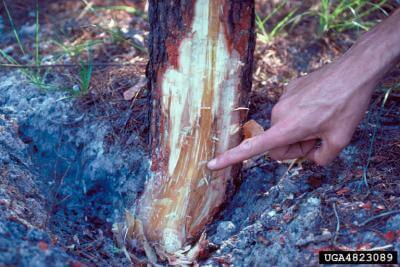
The American chestnut (Castanea dentata) and the related Allegheny and Ozark chinkapins (which are both varieties of Castanea pumila) probably began declining approximately 200 years ago with the introduction of the soil-borne algal fungus, Phytophthora cinnamomi. Throughout the 1800s, the disease gradually killed chestnut and chinkapin populations on relatively wet sites (Crandall et al., 1945).
The Phytophthora cinnamomi pathogen is widespread in soils south of 40o North Latitude (just north of the Maryland-Pennsylvania line). Several studies indicate that up to 80% of seedlings are killed. Scientists expect this pathogen to move north in response to the warming climate; indeed, some project that the root disease could reach throughout the entire current chestnut range by 2080. Warmer and wetter climates are expected to exacerbate the pathogen’s impact. On the other hand, The American Chestnut Foundation (TACF) has found some resistance to Phytophthora root rot in families providing blight resistance. TACF now plans to cross individuals from those families with transgenic blight-resistant chestnut to combine both resistances (Gustafson et al. 2022).
Gustafson et al. (2022) describe actions to minimize the risk from the pathogen in pursuing the goal of restoring American chestnut. These include breeding of resistance, careful selection soils in restoration sites, and nursery hygiene measures.
Episodes of oak decline have sometimes been blamed on P. cinnamomi but this has not been investigated conclusively. While several other Phytophthora species are also pathogenic to oaks, their scattered distributions lead scientist to conclude that they play a minor role in oak decline. P. cinnamomi mainly infects the root system (canker development on stems is limited by cold winter temperatures). Several recent studies have confirmed that fine root losses – consistent with P. cinnamomi infection – are driving oak decline events in moist low-elevation stands where inoculum levels of P. cinnamomi are higher. In colder areas – e.g., plant hardiness zones 6 and 7 – fine root regeneration is limited due to climatic constraints (See Jung et al. 2018).
USFS scientists and managers developed a conservation priority-setting framework for forest tree species at risk from pest & pathogens and other threats. The Project CAPTURE (Conservation Assessment and Prioritization of Forest Trees Under Risk of Extirpation) uses FIA data and expert opinion to group tree species under threat by non-native pests into vulnerability classes and specify appropriate management and conservation strategies. The scientists prioritized 419 tree species native to the North American continent. The analysis identified 15 taxonomic groups requiring the most immediate conservation intervention because of the tree species’ exposure to an extrinsic threat, their sensitivity to the threat, and their ability to adapt to it. Each of these 15 most vulnerable species, and several additional species, should be the focus of both a comprehensive gene conservation program and a genetic resistance screening and development effort. Phytophthora root rot is not known to be a threat to any of these 15 most vulnerable species.
Threats Elsewhere
Worldwide P. cinnamomi infects almost 5,000 plant species. In Europe, significant and increasing decline of evergreen oak trees has occurred (Jung et al. 2018; Wilkins, Whiley, and Ross, 2025).
The most damaging and best known outbreak is that in Western Australia. There the disease is causing severe mortality in jarrah and other forests. The region is recognized as a globally important biodiversity hotspot by World Wildlife Fund and Conservation International. More than 40% of the 5,700 plant species described (more than 2,300 species) can be killed by the pathogen (WWF report). In areas of heavy infection, devastation of the native plant communities can cause a cascade of declines in invertebrate, bird and mammal species due to loss of shelter, nesting sites and food sources (Makinson, 2018). As of the beginning of the 21st Century, the Western Australia outbreak was established on more than one million hectares of forests, woodlands, heathlands, as well as home gardens and horticulture properties. Affected properties include three National parks (WWF and Threat).
Phytopthora cinnamomi actually poses a nation-wide threat in Australia; severe impacts affecting tens to hundreds of thousands of hectares have been recorded in all jurisdictions except The Northern Territory. New South Wales designated the disease a “key threat” in 2003. Victoria listed two spread vectors as potentially threatening processes in 2016 (WWF and Threat). At the beginning of the 21st Century, 236 species—plants, birds, and mammals—had been designated as nationally threatened. Thirty-two ecological communities were considered similarly threatened (Threat; WWF).
Many of the plant taxa most threatened by Phytophthora dieback disease are in the Proteacea family, whereas the Australian taxa threatened by myrtle rust (Austropuccinia psidii) are in the Myrtaceae. Therefore, while both diseases are considered to threaten 40% of the plant species in Western Australia, there is only some overlap.
P. cinnamomi can be spread by any activity that moves soil, water or plant material, including recreational visits to natural sites, gardening, road building, timber harvesting and mining (Threat).
Chronology in Australia
Damage to jarrah trees (Eucalyptus marginata) was first noticed in the 1920’s, although its cause was not determined until the 1960’s. Over the next few decades, damage spread and authorities realized that hundreds or thousands of other plant species were also vulnerable (WWF). These developments prompted several government actions in the 1990’s:
- The Federal government adopted legislation designating Phytophthora dieback disease as a Key Threatening Process. The first designation was in 1992, under the Endangered Species Protection Act 1992 (Threat). A second designation came in 1999, after adoption of the Environment Protection and Biodiversity Conservation Act. A Key Threatening Process is defined as a process that threatens, or potentially threatens, survival, abundance or evolutionary development of a native species or ecological community. Other processes recognized were predation of native fauna by the European red fox, land clearance, and climate-change-driven loss of habitat [WWF].
- In 1995 or 1996 the Perth Metropolitan Area local government formed a Dieback Working Group. It comprises representatives of local governments, local community groups, the state Department of Environmental Protection, the former departments of Conservation and Land Management and Land Management, and affected industries (WWF).
- In 1997, the State of Western Australia formed the Dieback Consultative Council. Its members have a broad range of research and management expertise, or represent industry and other stakeholders. The Council advises the Minister for Environment on managing the disease. As part of this work the Council played a major role in establishing the Dieback Response Framework, which outlines strategies. A Dieback Response Group was formed to coordinate implementation (WWF report).
Adoption of the national “key process” designation prompted development of a national “Threat Abatement Plan” in 2001 (Threat). Revised plans have been adopted since, in 2014 and 2019. The 2019 plan apparently still applies. It has four objectives (Threat):
- identify and prioritize biodiversity assets for protection
- reduce spread and mitigate impacts on priority biodiversity assets
- inform and engage the community
- encourage research on Phytophthora species and infestation management.
As of 2004, scientists (WWF) estimated the cost to the Australian economy if Phytophthora dieback were not controlled to be $1.6AU billion over the next 10 years. This figure did not include economic costs arising from loss of ecosystem services. The report laid out a set of priority actions costing an estimated $43.6 million to manage the disease in the high-impact southwest region of just the one state, Western Australia (WWF). It is unclear which of these activities have actually been carried out. The report stresses the importance of volunteer “friend” groups which protect specific vulnerable sites.
Small infested areas can be controlled by repeated applications of phosphite—either through trunk injections or aerial spraying of whole plant communities (WWF).
The authors of the “Environmental Threats of National Significance” fact sheet point out that despite being listed as a Key Threatening Process since 1962, in the first decade of the 21st Century Phytophtora dieback disease continued to spread and cause declines of biodiversity. They wrote that it was not possible to recover all of threatened species through species-focused efforts. They called instead for a concerted national focus to overcome the major threats our native plants and animals have in common, in particular invasive species, climate change, habitat destruction, adverse fire regimes and changes to natural water flows. Australia needed an ambitious, better funded and nationally coordinated threat abatement system (Threat).
Sources
Anonymous. Environmental Threats of National Significance. Phytophthora. Threats to Nature Project. https://invasives.org.au/wp-content/uploads/2023/01/Threats-to-Nature-Field-Guide-Phytophthora-Rebranded.pdf
Crandall, R. S., G. F. Gravatt, and M. M. Ryan. 1945. Root disease of Castanea species and some coniferous and broadleaf nursery stocks caused by Phytophthora cinnamomi. Phytopath. 35: 162-180.
Gustafson, E.J., B.R. Miranda, T.J. Dreaden, C.C. Pinchot, D.F. Jacobs. 2022. Beyond blight: Phytophthora root rot under climate change limits populations of reintroduced American chestnut Ecosphere. 2022;13:e3917.
Jung, T., A. Pérez-Sierra, A. Durán, M. Horta Jung, Y. Balci, B. Scanu. 2018. Canker and decline diseases caused by soil- and airborne Phytophthora species in forests and woodlands. Persoonia 40, 2018: 182–220
Makinson, R.O. 2018 Austropuccinia psidii reviewed: the impacts of the invasive pathogen Austropuccinia psidii on the Australian environment. Plant Biosecurity Cooperative Research Centre, Canberra.
Potter, K.M., Escanferla, M.E., Jetton, R.M., Man, G., Crane, B.S., Prioritizing the conservation needs of US tree spp: Evaluating vulnerability to forest insect and disease threats, Global Ecology and Conservation (2019), doi: https://doi.org/10.1016/
Robin, C., F. Dupuis, and M. L. Desprezloustau. 1994. Seasonal changes in northern red oak susceptibility to Phytophthora cinnamomi. Plant Dis. 78: 369-374.
Robin, C., M. L. Desprez-Loustau, G. Capron, and C. Delaour. 1998. First record of Phytophthora cinnamomi on cork and holm oaks in France and evidence of pathogenicity. Ann. Sci. Forest. 55: 869-883.
World Wildlife Fund. Arresting Phytophthora dieback The Biological Bulldozer. https://forestphytophthoras.org/sites/default/files/educational_materials/dieback_report.pdf