



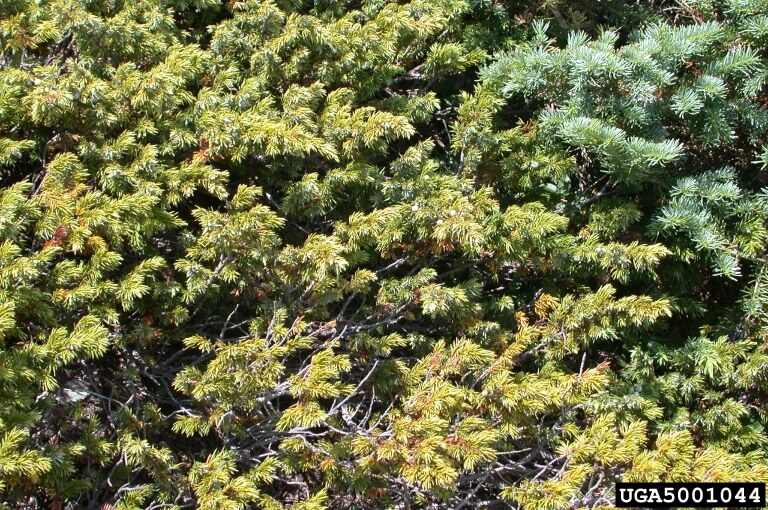
Phytophthora austrocedri
Chronista, Oomycota, Oomycetes, Peronosporales, Personosporaceae, Phytophthora
…in clade 8 of the Cooke et al. (2000) molecular phylogeny of the Phytophthora genus
Phytophthora austrocedri is an oomycete of unknown origin. It has been introduced to South America, Europe, western Asia, and North America. Although mortality of Cordilleran cypress (Austrocedurs chilensis) was noticed in the Patagonian region of Argentina as early as 1948 [Purdue CAPS datasheet; Forest Research UK], the causal agent was not identified until 2007. It was discovered to be a previously unknown species of oomycete, Phytophthora austrocedri. The pathogen is now thought to have been present in Argentina since at least the 1960’s [Forest Research UK]. There are some indications that P. austrocedri is also present in Chile [Purdue CAPS datasheet].
Cordilleran cypress, also called Chilean or Patagonian cedar (Austrocedrus chilensis), is an endemic, monospecific tree in the Cupressaceae family found in southern Argentina and Chile. There, the species forms pure and mixed stands with southern hemisphere beech (Nothofagus spp.) across ~ 160,000 ha (395,000 ac.) [Purdue CAPS datasheet].
The European incursion was detected in 2011. In Great Britain significant outbreaks have been detected in important conservation sites in Scotland and northern England, with a smaller number of cases in southern England [Forest Research UK]. Since 2020, the disease has also been detected in Wales [EPPO Global Database].
The host most severely affected, common juniper (Juniperus communis), was already considered to be of conservation concern in Great Britain before P. austrocedri was confirmed there. Since about 1990 the trees’ extent and condition have declined considerably, especially on upland sites, due to overgrazing, burning, afforestation, lack of regeneration and other land-use changes. P. austrocedri infection could accelerate this decline. Juniper is an important component in nature conservation and game management, and supports a unique and specialized group of associated insects, fungi, and lichens. Juniper is also an important food plant for a wide range of invertebrates. In Britain, P. austrocedri is also attacking Chamaecyparis lawsoniana (Lawson cypress), a North American conifer valued ornamental species [Forest Research UK].
P. austrocedri has probably been in Europe longer. A then-unknown Phytophthora was isolated on a creeping juniper (J. horizontalis) plant in an import-export nursery in Germany in the early 2000s [Forest Research UK]. British plant health officials have detected the species’ DNA on diseased tissues of young Juniperus, Chamaecyparis lawsonii, and Cuppressocyparis leylandii imported from mainland European countries (Henricot et al. 2017). The pathogen is reported to be no longer present in the German nursery [EPPO Global Database].
In Iran, P. austrocedri was been reported in 2017 on a single Mediterranean cypress (Cupressus sempervirens) in a public park (Forest Research UK].
The presence of P. austrocedri in North America was detected in September 2024, infecting plants in two Oregon nurseries [OAN.org]. State and federal phytosanitary authorities immediately quarantined affected plant material in both operations. Within a month, the USDA Animal and Plant Health Inspection Service (APHIS) met with the two Oregon nurseries to assess the situation. After analyzing production and shipping records from the nurseries, APHIS determined that it was highly likely that P. austrocedri has been in the nursery system for some time. The Oregon Department of Agriculture (ODA) reports it has probably been present for 10 years [ODA response letter]. This would put the date of introduction to the United States at about the same time as the species was detected in Europe and Iran.
APHIS and ODA decided that it was already too late to prevent spread of the pathogen from Oregon nurseries. This decision was reached in consultation with both the Oregon and national associations of nursery owners. Consequently they are treating P. austrocedri as a non-quarantine pest [OAN.org].
APHIS estimated that delimitation surveys in just one nursery would cost more than $9 million. Because the pathogen cannot be detected by visual symptoms, even tracking spread requires expensive destructive sampling of large numbers of plants. Meanwhile, thousands of possibly infected plants have been shipped from at least two Oregon nurseries in recent years. APHIS concluded that a Federal survey program for P. austrocedri would not contribute to ultimately controlling the spread or eradication of this pathogen. The agency recommended instead that natural resource agencies adopt a “protective-style approach”, focused on actively managing highest-value natural sites.
Hosts
Experience in the United Kingdom and Oregon indicates that Phytophthora austrocedri attacks several trees in the plant family Cupressaceae:
- Austrocedrus chilensis (Cordilleran/Chilean/Patagonian cypress)
- Juniperus communis (Common juniper)
- Chamaecyparis lawsoniana (Port-Orford cedar),
- Chamaecyparis nootkatensis (Nookta cypress; Alaska yellow cedar)
- Cupressus sempervirens (Mediterranean cypress)
- Juniperus horizontalis
Hosts detected by the ODA in Oregon include more species in the Cupressaceae:
- Other species in the Chamaecyparis genus (False cypress), including C. obtusa and C. pisifera
- Other species in he Juniperus genus, including J. chinensis, J. savina, J. scopulorum, J. squamata, and J. virginiana
- Thuja spp. (arborvitae), including T. occidentalis, and T. plicata
Many of these
proven hosts are native to North America. Alaska yellow cedar (Chamaecyparis nootkatensis) is present along the west coast from Alaska through British Columbia to California [Harris, USDA]. Port-Orford cedar DMF (Chamaecyparis lawsoniana) has a small, narrow range in parts of Oregon and California [Zobel, USDA]. Common juniper (Juniperus communis) grows in all Canadian provinces and more than 40 continental U.S. states. The exceptions are states from Nebraska south to Texas and east to Mississippi, and Florida [Purdue CAPS datasheet].
Eastern red cedar (Juniperus virginiana) grows in Oregon, Colorado, and all the states from the Great Plains east, as well as Quebec and Ontario [USDA NRCS ]. Arborvitae, also called northern white cedar (Thuja occidentalis), is native to the northeast and into Canada [Johnston, USDA]. T. plicata grows along the Pacific coast from Alaska to California [Minore, USDA].
America is home to many other species in the Juniperus genus that might be hosts. These include Juniperus californica, Juniperus grandis, Juniperus occidentalis, and Juniperus maritima. The juniper species growing in arid environments would probably be less vulnerable because Phytophthora austrocedri prefers cool, moist environments (Haricot et al. 2017).
Given the number of known and suspected hosts and their wide ranges across virtually all of North America, Phytophthora austrocedri has a potentially high risk of spread and likely environmental [Purdue CAPS datasheet]. Several of the host species are already under threat from other non-native pests. The species at greatest risk is Port-Orford cedar. The USDA Forest Service recently announced that POC trees bred to resist the introduced pathogen (also a Phytophthora, P. lateralis) are available for planting – a success rewarding decades of effort.
In the East, stressed urban plantings of arborvitae or northern white cedar (Thuja occidentalis) have been damaged by the Japanese cedar longhorned beetle (Callidiellum rufipenne), a wood boring beetle in the longhorned beetle family, Cerambycidae (Maier, 2007). Northern white cedar is already depleted by habitat loss. The beetle also feeds on two widespread eastern species, eastern red cedar (Juniperus virginiana) and common juniper (Juniperus communis) – although so far only on foliage damaged by other causes. According to Kristy McAndrew of the University of Mississippi (pers. comm.), the cedar longhorned beetle was first detected in natural forests in North Carolina in 1997 and shortly afterwards in several northeastern states. A decade later (in 2010 and 2011) it was detected in Pennsylvania and Maryland. In these regions it is feeding on live and declining or damaged trees. Dr. McAndrew is concerned about possible damage to other species in the Cupressaceae family which are of high conservation concern, such as bald cypress (Taxodium distichum) and Atlantic White Cedar (Chamaecyparis thyoides); both provide valuable ecosystem services in coastal and inland wetlands.
The wetland species might be particularly vulnerable to Phytophthora austrocedri, should it spread to the eastern regions because the pathogen prefers cool (50-68.5oF) and damp environments [Purdue CAPS datasheet].
Biology and Ecology
Phytophthora species form sporangia which produce zoospores that can move through water and swim towards new hosts. When a Phytophthora spore comes into contact with a susceptible host, it penetrates the bark and enters the phloem and xylem tissues of the plant. It grows both up and down from the lesion, killing the tissue. When these dead tissues girdle the tree, the foliage of the tree will turn red or brown and foliar dieback is visible [Purdue CAPS datasheet]. In the case of junipers, Phytophthora austrocedri attacks primarily the roots & stem bases [Purdue CAPS datasheet].
The epidemics in Argentina and Great Britain are thought to be caused by clonal populations [Purdue CAPS datasheet]. (Several Phytophthora have caused widespread damage to plants when spread as clones – e.g., P. infestans (potato blight), P. cinnamomi, P. ramorum.) As a homothallic organism, Phytophthora austrocedri can sexually reproduce to form oospores without mating. Although no research has been conducted specifically on P. austrocedri, in this genus, oospores are often a survival propagule with the ability to survive for years inertly. Scientists do not understand the relative importance of sexual and asexual reproduction in naturally occurring infections of P. austrocedri.
In the laboratory, Phytophthora austrocedri grows best at temperatures between 10 and 20°C. However, necrotic stem lesions expand at a faster rate when inoculations are done during the summer – leading to the expectation that specific environmental conditions promote infection. There are highly variable rates for lesion expansion and foliar symptom development [Purdue CAPS datasheet]. It thus appears that the disease is favored by environments with lower temperatures and higher precipitation. Like most Phytophthoras, it is also associated with poor soil drainage and saturated soils. The disease clusters in stands [Purdue CAPS datasheet].
Detailed studies have determined that there are two genetic strains of P. austrocedri: one found in Argentina and Germany, and a second found in Great Britain. They differ in subtle and probably significant ways. For example, while isolates of both strains grew best at 15oC, and all died at 25oC, the isolates from Argentina grew fastest at 20oC and the UK isolates stopped growing at 22.5oC. Overall, the UK isolates had lowest growth rate and least response to increased temperatures. The Argentine isolates caused longer lesions on A. chilensis than on J. communis; vice versa for British isolates. There were also significant differences in the length of the lesions caused by the various isolates and on the various hosts (Henricot et al. 2017).
Pathways of Spread
The pathways by which P. austrocedri has been introduced to South and North America and Europe have not been determined. It is particularly puzzling in Great Britain, where the pathogen is established in several geographically separate locations (Henricot et al. 2017). Experts suggest that transport via the international plant trade is a likely pathway (Henricot et al. 2017; Purdue CAPS datasheet; ODA response letter).
Most important is the fact that the two genetic strains should be treated by phytosanitary agencies as presenting separate risks. As Henricot et al. (2017) say, somewhere in world there exists a potentially large and genetically diverse source population that could be the source of introductions to yet more naïve regions. They urge scientists to search for the species’ center of origin. The authors of the CAPS alert [Purdue CAPS datasheet] say visual inspection at ports of entry is unlikely to restrict the movement of this pathogen.
US Regulations
Importation
of Juniperus spp. (all propagules except seeds) has been prohibited from Europe since 2018. It is not known whether P. austrocedri can be seedborne. There appear to be no regulatory restriction on imports of at least some of the other hosts (e.g., Chamaecyparis spp.) [Purdue CAPS datasheet].
Before 2025, the USDA Forest Service Forest Health Protection program would assist states in surveying their forests for signs of infection of Juniperus, Chamaecyparis or Thuja trees and deciding how to manage this pests. Cutbacks to the USFS programs make it uncertain whether such assistance will continue to be offered. Still, the Agriculture Research Service has provided nearly $250,000 available to study the threat it represented [Gray, 2024]. And the Fiscal Year 2026 Plant Protection Act Section 7721 Implementation Plan lists Phytophthora austrocedri as a program priority – although the text warns that does not guarantee funding for projects addressing it.
While ODA also is not regulating this pathogen in Oregon, it is encouraging nurseries to implement best management practices to address this Phytophthora species. The ODA has funding to survey Oregon nurseries to better understand the potential spread of this novel pathogen within commercial nurseries. As noted above, researchers at Oregon State University and USDA ARS will conduct host pathogenicity and fungicide trials [ODA response letter].
United Kingdom Regulations
As of the writing of this pest profile, the United Kingdom has not updated its official web page on Phytophthora austrocedri since 2021. Importation of Juniperus and Chamaecyparis species from non-European Union countries were banned under European Union phytosanitary legislation. Apparently this prohibition remains in force. Other host species are not prohibited, but they must be accompanied by a phytosanitary certificate declaring that they are free from harmful organisms [Forest Research UK].
Sources
[EPPO Global Database] Website: https://gd.eppo.int/taxon/PHYTAU/distribution
[Forest Research UK] Website: https://www.forestresearch.gov.uk/tools-and-resources/fthr/pest-and-disease-resources/phytophthora-austrocedri-disease-of-juniper-and-cypress/
Gray, J. 2024. Horticultural Research Institute Announces Research Effort to Combat Phytophthora austrocedr. Online article: https://www.hriresearch.org/hri-announces-research-effort-to-combat-phytophthora-austrocedri
Henricot, B., Perez-Sierra, A., Armstrong, A.C., Sharp, P.M., and Green, S. 2017. Morphological and Genetic Analysis of the Phytophthora austrocedri Reveal that Two Clonal Lineages Colonized Argentina from a Common Ancestral Population. Phytopathlogy, 107 (12):1532-1540 https://doi.org/10.1094/PHYTO-03-17-0126-R
[Johnston, USDA] Online publication: https://www.srs.fs.usda.gov/pubs/misc/ag_654/volume_1/thuja/occidentalis.htm
Maier, C.T. 2007. Distribution and hosts of Callidiellum rufipenne (Coleoptera: Cerambycidae), an Asian Cedar Borer Established in the Eastern United States. Journal of Economic Entomology, 100(4)
[Minore, USDA] Online publication: https://www.srs.fs.usda.gov/pubs/misc/ag_654/volume_1/thuja/plicata.htm
[OAN.org] Oregon Association of Nurseries, November 2024 news article: https://www.oan.org/news/686882/APHIS-expects-Phytophthora-austrocedri-to-be-listed-as-non-quarantine-pest.htm
[ODA Response Letter] Online PDF: https://olis.oregonlegislature.gov/liz/2025R1/Downloads/CommitteeMeetingDocument/296700
[Purdue CAPS datasheet] Online PDF: https://caps.ceris.purdue.edu/wp-content/uploads/2025/07/Phytophthora-austrocedrae-CAPS-datasheet-201808311.pdf
[Zobel, USDA] Online publication: https://www.srs.fs.usda.gov/pubs/misc/ag_654/volume_1/chamaecyparis/lawsoniana.htm